The Midnight Snack Dilemma
You’re on a diet. The smell of fried chicken fills the air. Two voices speak up simultaneously:
- Voice A: “Eating now means exceeding today’s calorie limit. Stay strong.”
- Voice B: “It smells so good… just one piece…”
Sound familiar? Psychologists Pacini and Epstein argue this isn’t random—it’s the result of two independent information processing systems running in parallel inside your brain.
Two Systems: “The Thinker” vs “The Feeler”
graph LR
    subgraph Rational System
        A[Conscious] --> B[Slow]
        B --> C[Step-by-step reasoning]
        C --> D[Verbally explainable]
    end
    subgraph Experiential System
        E[Preconscious] --> F[Fast]
        F --> G[Intuitive judgment]
        G --> H[Hard to explain]
    end
“The Thinker” (Rational System)
| Feature | In brief | Example |
|---|---|---|
| Conscious | Aware of thinking | “Wait, let me calculate this” |
| Slow | Takes time | Comparing prices for the best deal |
| Sequential | Step-by-step | “A implies B, B implies C” |
| Explainable | Can justify | “This product is better because…” |
“The Feeler” (Experiential System)
| Feature | In brief | Example |
|---|---|---|
| Preconscious | Unaware of why | “I just feel uneasy” |
| Fast | Nearly instant | Judging someone’s first impression |
| Holistic | Grasps the whole | “This place has a nice vibe” |
| Hard to explain | “Just a feeling…” | “I can’t explain why, but this feels right” |
Key insight: These two systems are independent. Being strong in one doesn’t mean being weak in the other. A person can be high in both, or low in both.
The Jellybean Experiment: When Intuition Beats Logic
The researchers gave 144 participants a simple choice:
- Small tray: 10 jellybeans, 1 red → Win probability 10%
- Large tray: 100 jellybeans, 9 red → Win probability 9%
Pick a red jellybean = win money!
Logically, the small tray (10%) is the better bet. But the large tray looks like it has more red jellybeans. The results?
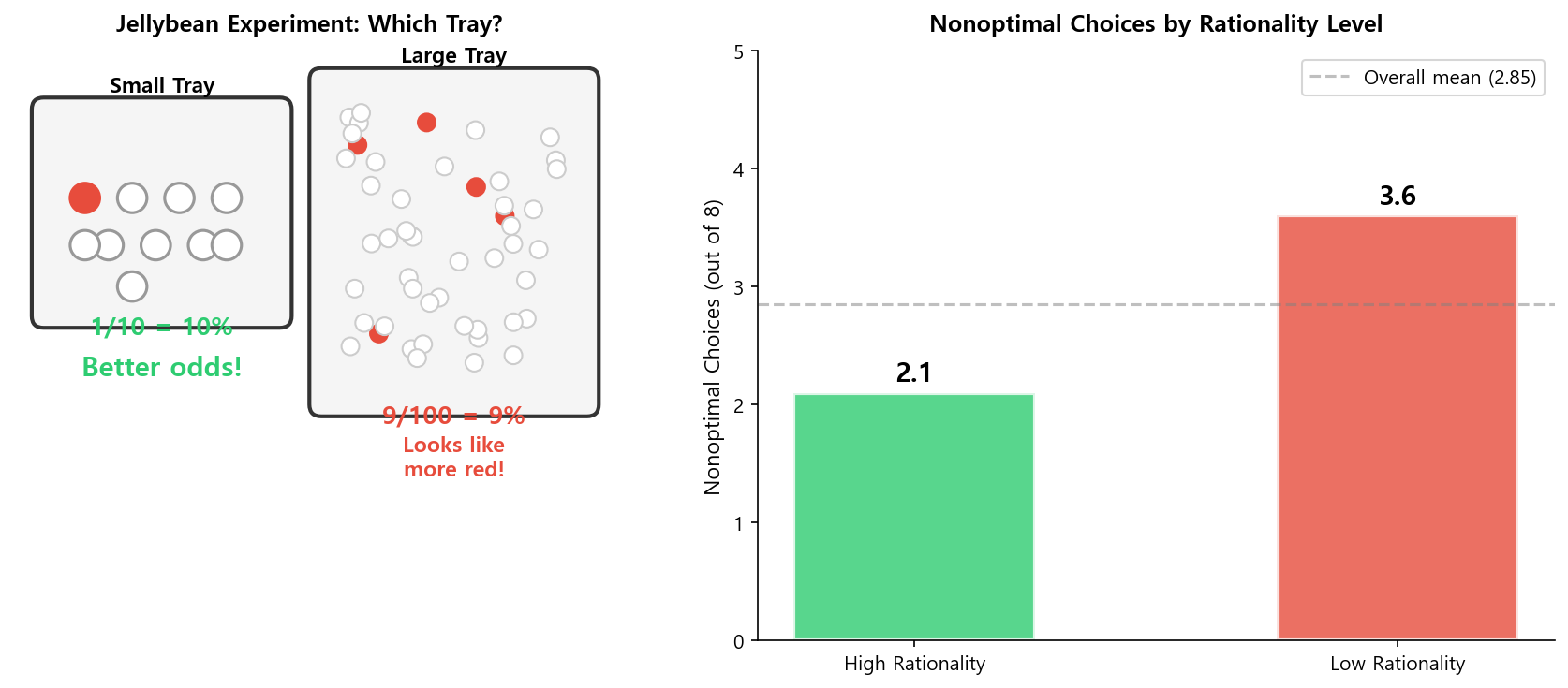
- A full 84% of people made at least one suboptimal choice
- High-rationality participants averaged 2.1 suboptimal choices (vs 3.6 for low-rationality)
- When stakes increased, people high in experientiality but low in rationality made even more suboptimal choices
“The Feeler” gets more excited as stakes rise—“The one with more red!” “The Thinker,” when strong enough, pumps the brakes: “Hold on, let’s check the math.”
Personality Profiles of Each Thinking Style
What are people with strong rational vs. experiential systems like? A survey of 399 participants revealed:
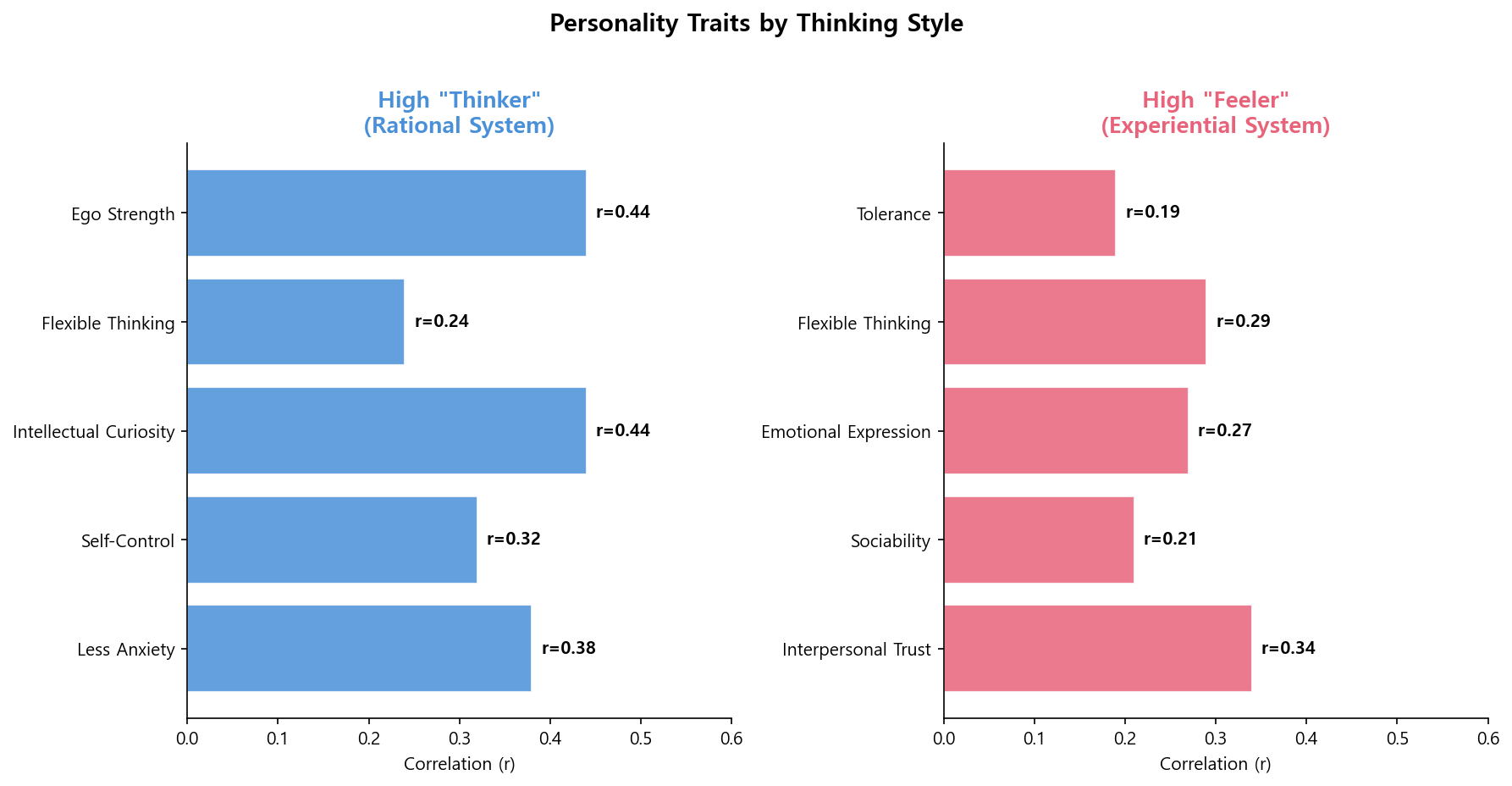
High “Thinker” Profile
- Less anxiety and depression (not swayed by emotions)
- Higher self-control (does what needs to be done)
- Greater intellectual curiosity (loves learning new things)
- Less dogmatic (doesn’t insist “I’m always right”)
High “Feeler” Profile
- Better interpersonal trust (trusts people, builds relationships)
- More sociable (enjoys meeting people)
- More emotionally expressive (shows joy when happy, sorrow when sad)
- Less black-and-white thinking (more flexible)
How REI Differs from Standard Personality Tests
Can the Big Five personality traits (Openness, Conscientiousness, Extraversion, Agreeableness, Neuroticism) explain what REI measures?
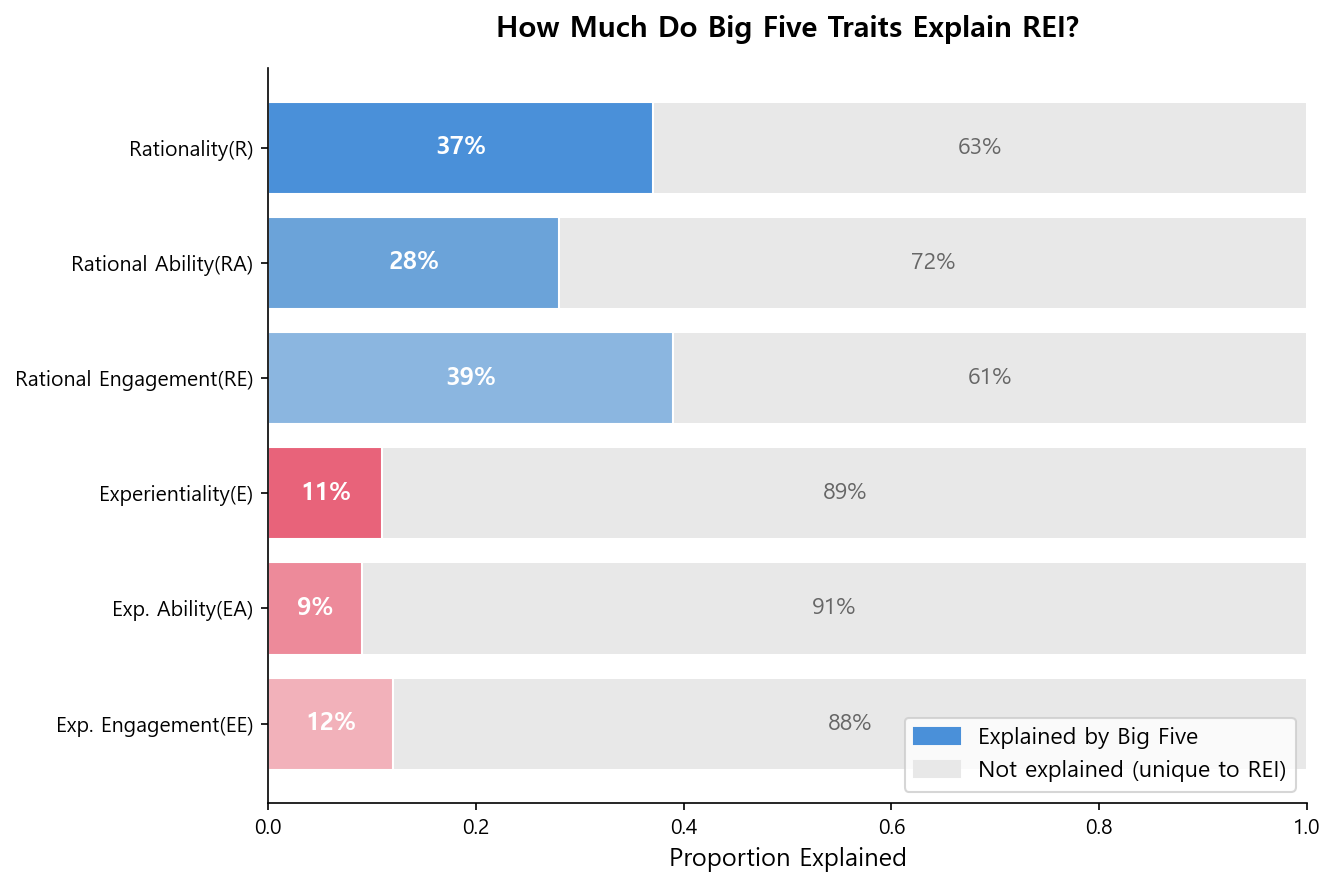
- Rationality: 63–72% of variance is not explained by Big Five
- Experientiality: 88–91% of variance is not explained by Big Five
The “thinking style” measured by REI captures a unique dimension that traditional personality tests miss.
The 6 Scales of REI-40
The REI-40 measures each system along two dimensions — ability and engagement:
- RA (Rational Ability): Self-assessed analytical competence
- RE (Rational Engagement): Enjoyment of cognitive effort
- EA (Experiential Ability): Self-assessed intuitive competence
- EE (Experiential Engagement): Reliance on intuition/feelings
- R (Rationality): Overall rational processing = RA + RE
- E (Experientiality): Overall intuitive processing = EA + EE
Gender Differences
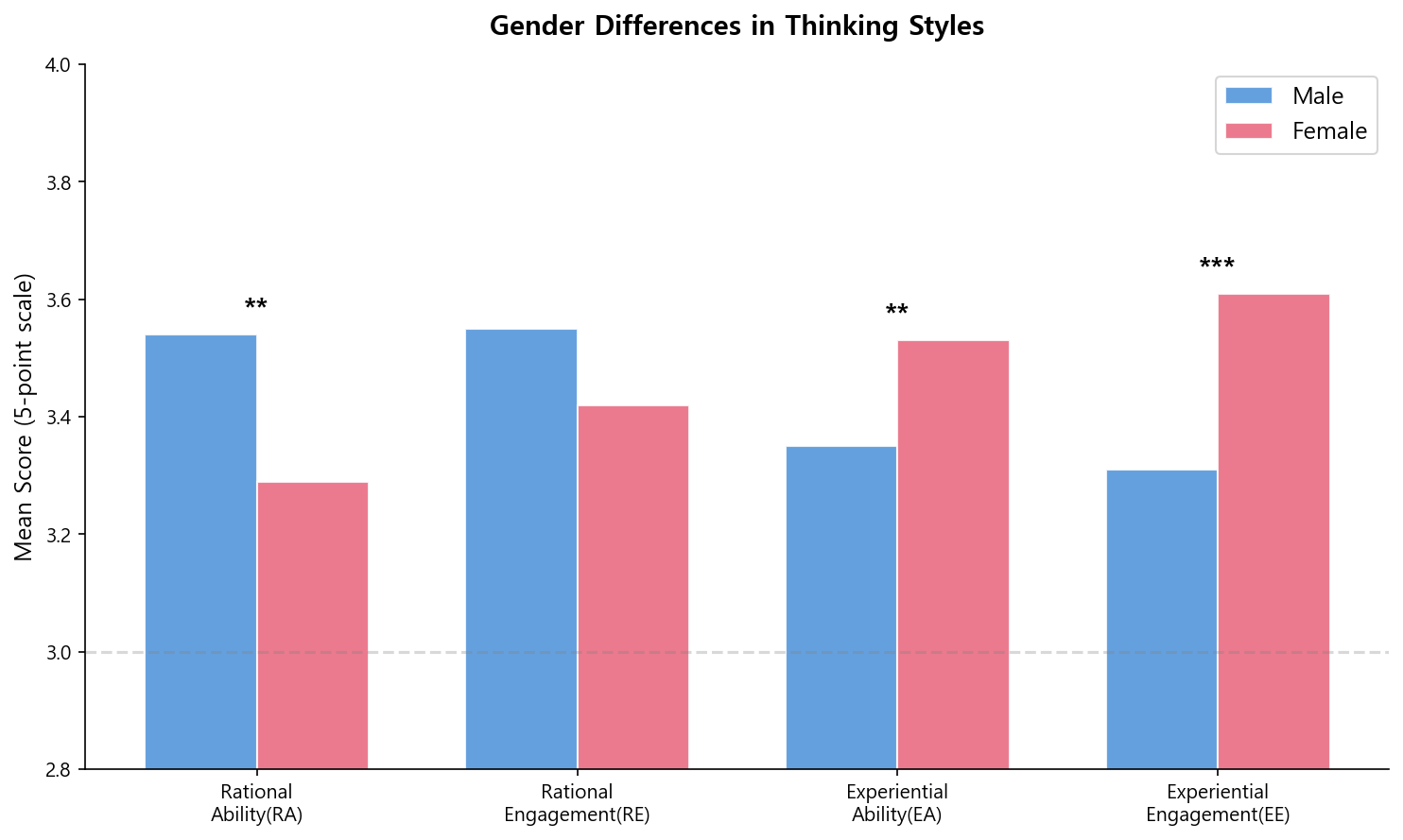
- Men: Rate themselves higher in rational ability
- Women: Rate themselves higher in experiential ability and engagement
- But no gender difference in “enjoying thinking” (rational engagement)
Caveat: These are self-reports, so social expectations may play a role.
Key Correlation: Independence Confirmed
The correlation between the two main scales:
| REI Scale | Rationality | Rat. Ability | Rat. Engagement | Experientiality |
|---|---|---|---|---|
| Rationality | 1.00 | |||
| Rat. Ability | .91 | 1.00 | ||
| Rat. Engagement | .92 | .68 | 1.00 | |
| Experientiality | -.04 | -.06 | -.02 | 1.00 |
The correlation between Rationality and Experientiality: r = -.04 (essentially zero). Strong evidence that the two systems are truly independent.
Ability vs. Engagement: Being Good at It vs. Enjoying It
REI measures each system on two subdimensions: “ability” (how good you are) and “engagement” (how much you enjoy it).
| Type | Example |
|---|---|
| High ability + High engagement | Good at math and loves it |
| High ability + Low engagement | Good at math but hates it |
| Low ability + High engagement | Struggles with math but finds it fun |
| Low ability + Low engagement | Bad at math and doesn’t care |
Interesting finding: People who enjoy a processing style (high engagement) are more flexible and tolerant than those who are merely good at it.
Does Strong Intuition Mean Biased Thinking?
Many assume “relying on gut feeling = bias.” The data shows the opposite:
People with strong intuition were actually more flexible and tolerant.
Intuition isn’t “biased thinking”—it’s “a different way of thinking.”
Real-Life Implications
graph TD
    A[Situation arises] --> B["The Thinker" evaluates]
    A --> C["The Feeler" evaluates]
    B --> D{Agreement?}
    C --> D
    D -->|Yes| E[Quick decision]
    D -->|No| F[Deliberation & compromise]
    F --> G[Final behavior]
Everyone has both systems. You can be high in both or low in both.
Each excels at different things.
- Logic → emotional regulation, self-control
- Intuition → relationships, empathy, flexible thinking
Logic serves as the brake. When intuition pulls you the wrong way (especially with high stakes), logic says “Wait.”
Most behavior is a compromise. Purely logical or purely intuitive actions are rare.
Try It Yourself: REI-40
Take the REI-40 right here. Answer all 40 items honestly and your scores will be calculated automatically.
1 = Definitely not true / 2 = Not true / 3 = Neutral / 4 = True / 5 = Definitely true
Your REI Profile
Norm Comparison (N=399 college students)
Limitations
- College students only: Results may not generalize to other ages or cultures
- Self-report measures: People who say “I’m logical” may not actually be
- Experiential structure: The ability/engagement distinction wasn’t as clean for the experiential scale
Related: LLM Experiment
Curious how LLMs score on the REI-40? We tested 5 frontier models — see the full results in Do LLMs Have Thinking Styles? REI-40 Experiment on 5 Frontier Models.
Reference
Pacini, R., & Epstein, S. (1999). The relation of rational and experiential information processing styles to personality, basic beliefs, and the ratio-bias phenomenon. Journal of Personality and Social Psychology, 76(6), 972-987.