My father was from Gurye, Jeollanam-do. There were partisan ties in his family, and he grew up hearing from the neighbors that studying was pointless. Still, he graduated middle school, moved to Seoul, and worked his way through school while supporting his family as the eldest of five siblings. When I visited my grandmother’s house as a child, a crumbling traditional Korean house still stood there. The life that began in that place is beyond what I can imagine from where I stand now.
During the Middle East construction boom of the 1980s, my father was dispatched to Saudi Arabia as an unskilled laborer through Hansin Engineering & Construction. He had no particular skills to speak of. But within a year, he learned surveying on site and became a surveyor. Once he became a surveyor, the company gave him a car and two Pakistani assistants. I also spent some time in the Middle East because of my wife’s job. At midday, it approached 50 degrees Celsius — impossible to go outside. But I wandered around in massive air-conditioned malls, so it wasn’t hard for me. My comfort was probably built on the blood and sweat of countless fathers like mine. My father had a small black spot on his cheek, about the size of a pinky nail, from those days. With the money he had earned, he returned to Korea, opened a small business, and married my mother. And then I was born.
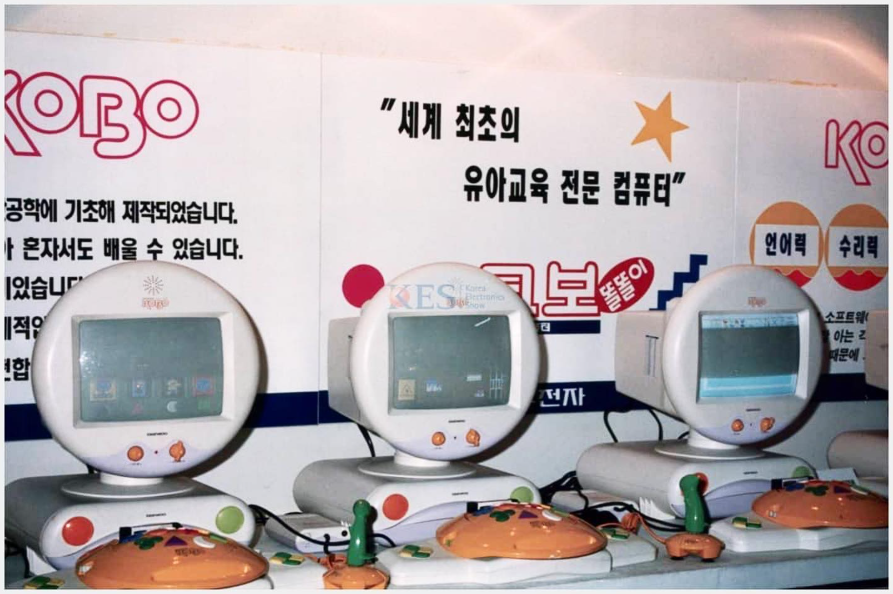
In 1990, he bought a children’s computer called the “KOBO” from Daewoo Electronics for his five-year-old son. We were living in a single rented room at the time, and I still don’t understand how he managed it. It cost 600,000 won — not a small sum at the time. It had a white keyboard-integrated body, a dedicated monitor with a round frame, and a joystick bundled as a set. It was an MSX-compatible machine. There was a cartridge slot on the top of the keyboard where you could plug in game packs. But all I did as a young child was play games all day. Without a cartridge inserted, the screen showed MSX BASIC on a blue background. The cursor blinked. About all a five-year-old could do with it was type 10 PRINT "HELLO". At the time, my father himself was not good with computers. But he wanted his son to be.
A few years later, my father bought a 486 DX from Sejin Computer Land. And he was serving as the SysOp of a club called “Jukmagowoo” on HiTEL, Korea’s early online service. This was the era of dial-up PC communications. He said he wasn’t good with computers, but in retrospect, running an online community was hardly a casual user’s activity. His curiosity about new things must have been that strong. Thanks to him, I got exposed to online communications and the internet earlier than most of my peers.
When I was in upper elementary school, my father put everything he had into opening an English language academy. He didn’t speak English. Yet he recruited native English-speaking teachers from overseas via the internet and brought them to Korea. With nothing but a translation program. A translation program from the late 1990s would have been incomparably crude by today’s standards. With that, he communicated with foreigners, negotiated employment terms, and actually got them to come to Korea. He demonstrated with his own actions that you can achieve your goal even with imperfect tools. The name “rick” that I use today was given to me by the first native teacher he brought over from Canada.
My father passed away three years ago. He had been studying AWS right up until the end. He was self-teaching a service that even professional developers find challenging, in his late sixties. I don’t know what he was trying to build. Perhaps there was no specific goal. He was probably just curious. He had always been that way.
If his wish had come true, I should be the next Linus Torvalds by now. In reality, I ended up as a decent software developer. It’s only with age that I’ve come to appreciate what my father did. Even with imperfect tools and difficult circumstances, he would dive in headfirst and produce results. I truly wish I had shown him that respect while he was alive.